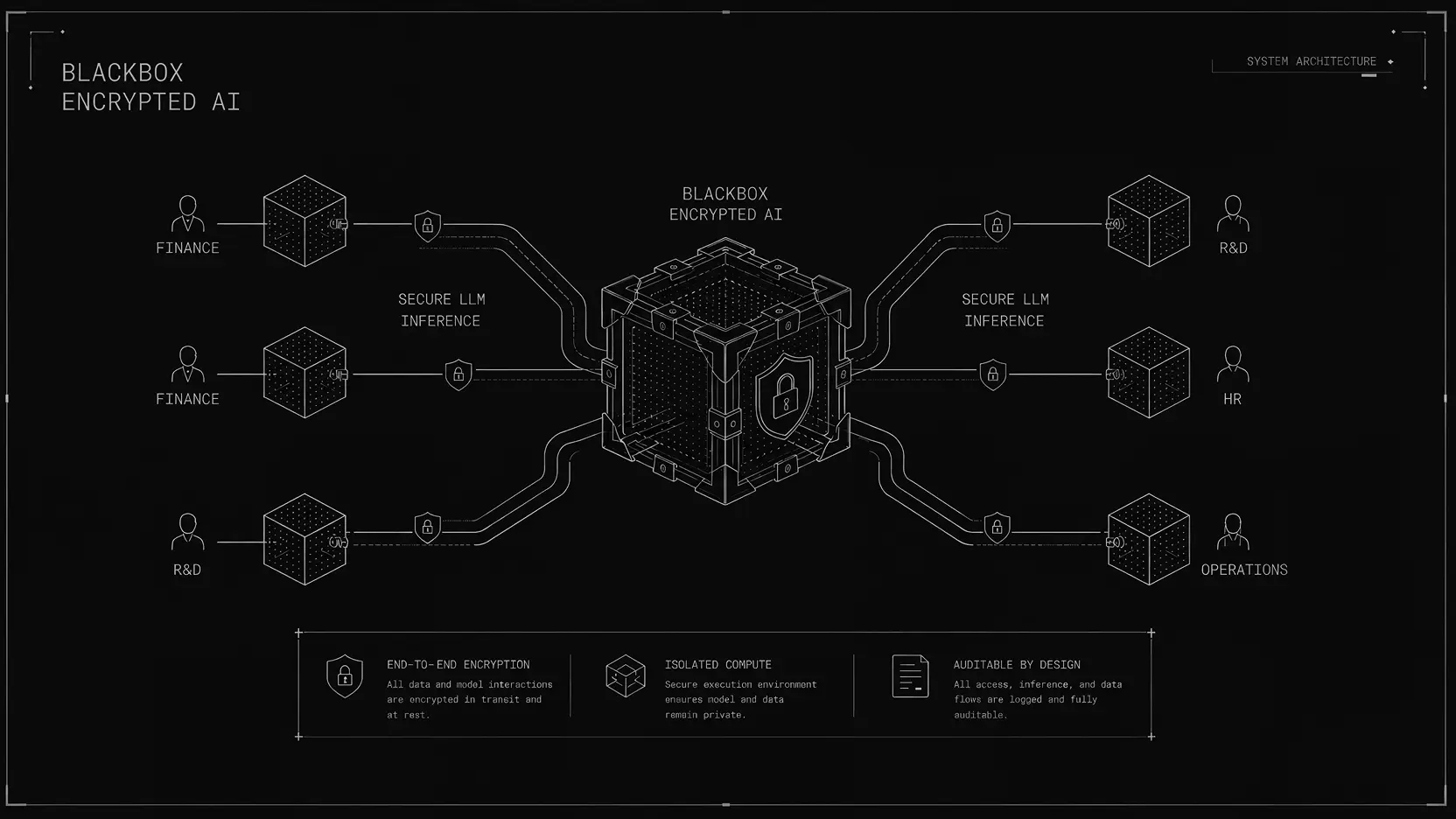
GPT-4o costs $10 per million output tokens. Blackbox Encrypted Nemotron costs $0.45, and adds end-to-end encryption, hardware attestation, and zero plaintext logs. For teams handling legal documents, healthcare records, or proprietary source code, that combination changes which AI workflows are technically possible.
That is the core promise of Blackbox Encrypted AI. It is a secure AI inference platform designed to keep prompts and responses encrypted from the application boundary all the way into a verified execution environment. Instead of relying only on transport security and policy statements, Blackbox Encrypted AI adds application-layer encryption, hardware attestation, and strict key management so that sensitive conversations can be processed with a much tighter trust model.
For developers and technical leaders, that shifts the architecture conversation. You stop asking, "Can we send this prompt over TLS?" and start asking, "Can we prove the worker is genuine before we release secrets, and can we keep the data encrypted throughout the session?" That shift matters because LLM usage is often limited not by model quality, but by data governance. When teams can't guarantee confidentiality, they either avoid the workflow or build brittle compensating controls.
Blackbox Encrypted AI closes that gap with an end-to-end encrypted inference flow built around API authentication, secure worker attestation, ephemeral session establishment, AES-256-GCM encryption, and encrypted streaming or non-streaming chat endpoints. The result is a platform engineered for sensitive prompts rather than retrofitted for them.
What Encrypted AI Inference Actually Means
Blackbox Encrypted AI is a confidential LLM inference service hosted at https://encrypt.blackbox.ai. Its defining characteristic: prompts are encrypted before they leave your application, and only a verified secure worker can decrypt them inside the trusted execution path. The platform supports both standard and streaming chat flows, with a strong emphasis on minimizing exposure of plaintext data.
Conventional LLM APIs rely on a trust stack that many enterprises are increasingly uncomfortable with. In a typical setup, plaintext is visible to the client application, the network path, API gateways, logging systems, and ultimately the provider's infrastructure. Even when those layers are well managed, the organization still has to trust that no misconfiguration, intermediary exposure, or operational accident leaks sensitive content. For regulated or high-confidentiality workloads, that trust assumption is too broad.
Blackbox reduces that exposure by combining API key authentication for access, hardware attestation for worker verification, and client-side encryption with AES-256-GCM. The platform also supports key management (budgets, expiry dates, revocation) so access aligns with user lifecycle and financial controls. That makes it practical to provision one key per user, one key per tier, or short-lived access for contractors and project-based teams.
The practical effect: you can build LLM features without handing plaintext to every layer of the delivery chain. That opens the door to use cases previously too sensitive for ordinary APIs: legal document analysis, confidential internal copilots, incident response workflows, pre-release product planning. Blackbox Encrypted AI reframes LLM usage from a convenience problem into a controlled security problem.
Why TLS Isn't Enough for LLM Prompts
Encryption is not just a data protection feature; it changes who you have to trust. TLS protects data in transit, but it does not prevent the service provider or intermediate infrastructure from seeing plaintext once it arrives. Your trust model still depends on the cloud environment, application logs, internal operators, and surrounding systems. With Blackbox Encrypted AI, the prompt and response are protected at the application layer, so plaintext is never broadly exposed outside the verified worker boundary.
“TLS asks: can someone on the wire read my traffic? End-to-end encryption answers a stronger question: can any system other than the intended trusted endpoint read the message at all?”
That difference is critical. For LLM conversations that contain source code, contracts, health data, customer records, or internal strategy, the stronger guarantee is the one teams actually need. It also changes the risk profile of vendor trust. Instead of trusting a provider because of policy statements, you verify the worker environment through attestation before secrets are released. Blackbox isn't asking you to accept confidentiality as a promise; it's giving you a cryptographic workflow that proves the worker is in the expected state before the conversation begins.
The result is a narrower trust boundary. Your backend owns the API key, your client establishes an encrypted session, and the worker must prove it is genuine before it can participate. The service still processes the model inference, but it cannot casually inspect your prompts in plaintext on the way in. Encryption doesn't merely protect transport; it reshapes the whole conversation lifecycle around confidentiality.
How a Secure Session Works, Step by Step
A secure session with Blackbox Encrypted AI follows a deliberate sequence. Your application obtains or creates an API key. Your client verifies the secure worker via the attestation endpoint. Only after the worker's identity and environment are validated does the client establish an encrypted session and begin sending chat requests.
At a high level:
1. Create or obtain an API key.
2. Request worker attestation.
3. Verify the attestation evidence.
4. Perform an ephemeral key exchange.
5. Derive a shared session secret.
6. Encrypt the prompt payload.
7. Send the encrypted request to /message or /message_stream.
8. Decrypt the response on the client side.
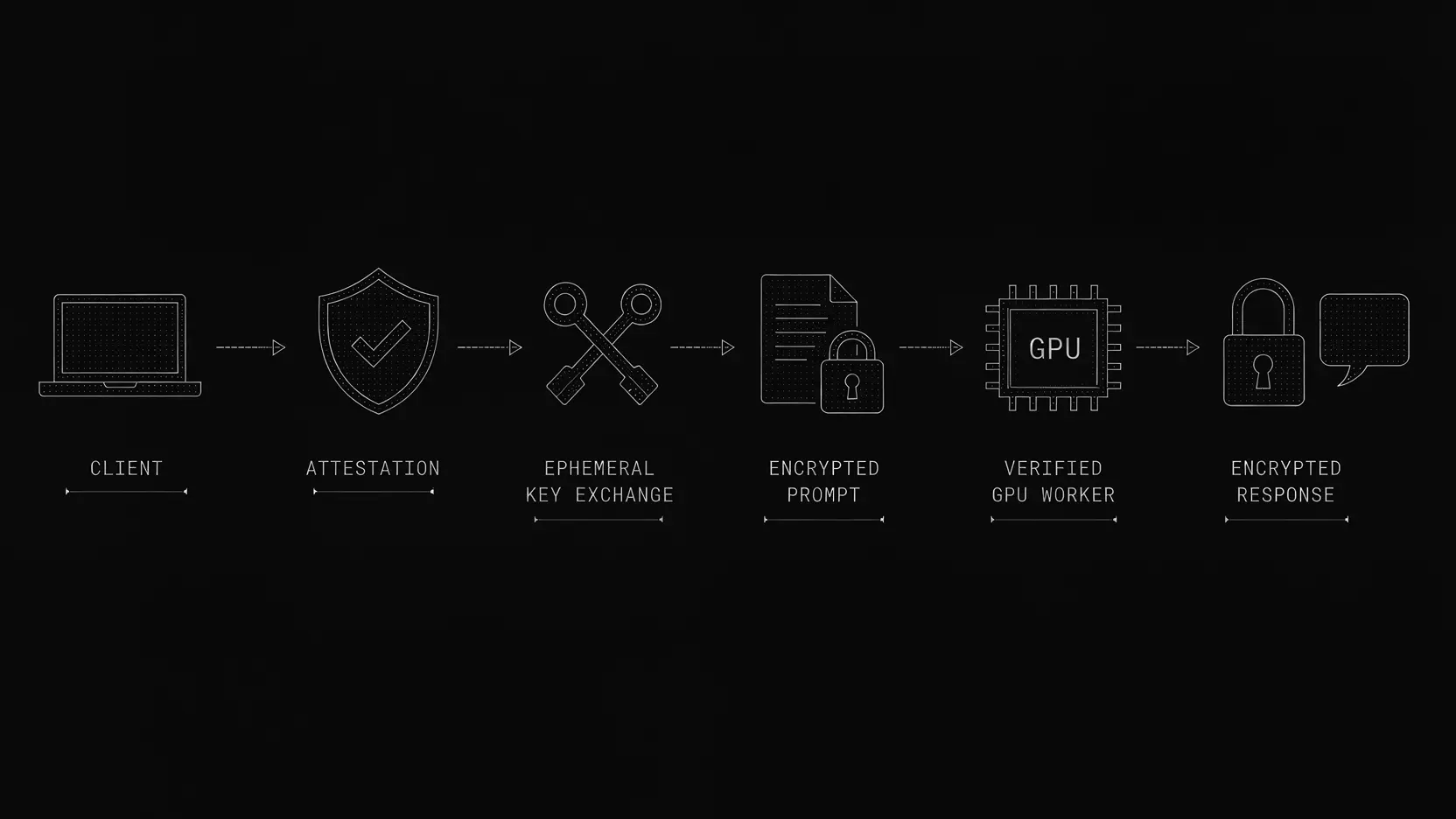
This flow is intentionally defensive. The API key controls access and billing, but does not replace encryption. The attestation step prevents secrets from being released to an unverified environment. Key exchange establishes fresh session material so each conversation is isolated. The encrypted message endpoints keep the payload protected while the model runs.
In practice, this means your integration should be built around a backend or trusted service layer, not a public browser-only client. The API key belongs in secure server-side code, and the encrypted session should only be established after attestation succeeds. The Blackbox Python client SDK handles much of this automatically: attestation, key exchange, encryption, decryption, streaming response handling. If you implement your own client, you reproduce those steps carefully and preserve the nonce discipline that prevents replay and ordering attacks.
How the Worker Proves It's Genuine
Attestation is what makes the security model more than "encrypted in theory." Before your application sends sensitive data, it needs evidence that the inference worker is genuine and running in the expected trusted environment. Blackbox Encrypted AI exposes an attestation endpoint that returns the worker's public key, a nonce, attestation documentation, and server information. That gives the client enough material to verify freshness and legitimacy before establishing a session.
If a malicious or tampered worker could impersonate the real one, encryption alone wouldn't help. The client might still send a sealed message, but it would be sealed for the wrong recipient. Attestation closes that gap by binding the cryptographic session to a verified execution environment. Encryption protects confidentiality; attestation protects recipient authenticity.
The workflow is straightforward in concept and exacting in implementation. The client requests attestation, checks the response against the expected trust conditions, and confirms the attestation corresponds to the current session nonce. Then the client performs an ephemeral ECDH key exchange using the worker's public key. That shared secret becomes the basis for the session key used to encrypt the prompt payload.
A useful way to think about this: the worker has to earn the right to receive plaintext. It doesn't get the prompt because it sits behind an API endpoint. It gets the prompt only after proving it runs in the correct environment, and only after the client derives a fresh shared key for the session. That's a strong pattern for confidential AI workloads because it prevents blind trust in the infrastructure and forces the system to prove itself before secrets are released.
Encrypted Streaming Without Losing the UX
Streaming is often where practical LLM UX becomes compelling. Users want partial results quickly, not just a full answer at the end. Blackbox Encrypted AI supports this with POST /message_stream, which returns Server-Sent Events while preserving encryption across the stream. Chunks of the response are handled as encrypted data and decrypted on the client as they arrive.
The critical security property: streaming doesn't weaken the encryption model. Each chunk remains protected in transit and stays associated with the session's cryptographic context. The stream ends with a terminal [DONE] event so the client knows the response is complete. You preserve responsiveness without sacrificing confidentiality.
For chat interfaces, secure copilots, and analysis tools where latency matters, encrypted streaming is ideal. Users start reading the model's output while the worker continues generating later tokens. The client decrypts and renders chunks incrementally, keeping the interaction fluid. The same trust rules apply behind the scenes: only authenticated requests can use the endpoint, only verified sessions can decrypt outputs, and the worker only participates after attestation and key exchange are complete.
Streaming introduces implementation discipline. Your client must preserve ordering, handle partial delivery, and treat each chunk as part of an authenticated session. If the stream is interrupted, the client should fail closed rather than guess at missing content. A secure streaming design isn't only about encryption; it's about correct state handling under network instability. Blackbox Encrypted AI gives you real-time UX paired with a confidentiality-first architecture, which is what most enterprise teams actually need.
Multi-Turn Conversations With Replay Protection
Multi-turn LLM conversations are where session design matters most. A user asks a follow-up, refines a previous request, or continues a long analysis over several turns. In Blackbox Encrypted AI, the client maintains conversation context and sends the relevant encrypted history with each request. The server keeps no plaintext session state between turns, so the client remains responsible for preserving dialogue continuity.
The security benefit: it minimizes server-side exposure. Because the platform doesn't retain a plaintext conversation log, there's less opportunity for accidental leakage through persistence, analytics, or debugging systems. The flip side: the client must be disciplined about state handling. If you want the model to remember prior context, you supply it on each turn in encrypted form.
Nonces are central to replay protection. Each message includes an incrementing nonce counter, which lets the system reject replayed or out-of-order ciphertext. An attacker can't capture an old encrypted request and resend it to elicit a duplicated result or confuse session state. Nonce discipline is especially important in multi-turn systems because the conversation itself is stateful, and the order of messages affects the meaning of the exchange.
Operationally, treat the session like a secure transcript rather than a server-managed chat object. You control the history, the worker verifies the session, and each message is cryptographically tied to the current state. If a session is lost or the worker changes, the client should re-establish the session rather than assuming continuity. Less convenient than fully server-managed chat memory, and exactly what you want when confidentiality and integrity matter more than persistence convenience.
How the Server and GPU Worker Are Hardened
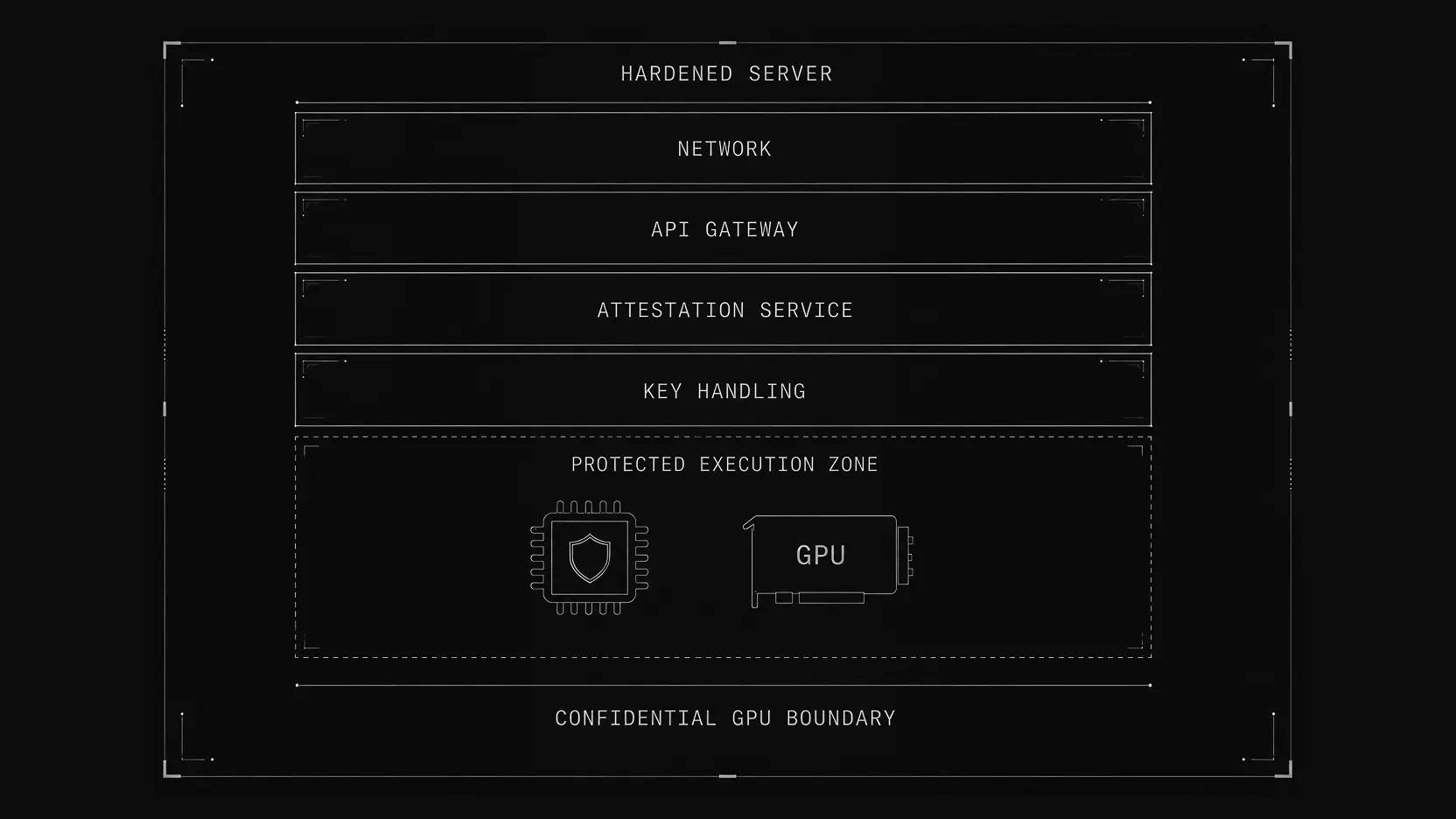
The security architecture behind Blackbox Encrypted AI is built on the principle that the worker must be verified, isolated, and limited. The public service surface exposes only a small set of endpoints: health checks, attestation, encrypted message submission, and key management. The actual inference happens on a secure GPU worker that runs in a trusted environment and proves that environment through attestation.
At the systems level, the architecture is designed to reduce what surrounding infrastructure can learn. Infrastructure logs capture metadata (timing, byte counts, key alias), not prompt or response plaintext. That distinction matters because many real-world leaks happen not through the model itself, but through operational artifacts: verbose logs, tracing systems, debug output, misconfigured telemetry. Keeping plaintext outside those systems reduces attack surface.
The worker itself is hardened by the fact that it must remain attestation-verifiable. If the runtime is tampered with, the attestation process fails or refuses to begin a session. That gives the client a meaningful control: no attestation, no secrets. Combined with ephemeral session establishment and encrypted payloads, the architecture makes it substantially harder for an attacker to extract useful plaintext from transit, logs, or compromised intermediaries.
There's also an architectural separation between access control and confidentiality. API keys determine who may use the service and how much they may spend; encryption and attestation determine who may see the data. That separation is a strong design pattern: it prevents billing credentials from being confused with security guarantees. A user can be authorized to call the service without being trusted to receive plaintext outside the encrypted session boundary.
What Encryption Protects, and What It Doesn't
Good security architecture starts with a clear threat model. Blackbox Encrypted AI protects against several important classes of risk, and is explicit about where it does not:
- Plaintext exposure on the network path
- Casual inspection by infrastructure layers that never receive the decryption key
- Tampered or unverified workers: sessions cannot start without attestation
- Replay attacks across multi-turn conversations via nonce ordering
- Plaintext leakage through infrastructure logs and telemetry
- Compromise of your own backend or trusted client endpoint
- Stolen API keys with no budget cap or expiry
- Client mishandling of key storage, nonces, or session persistence
- Endpoint malware that observes plaintext after decryption
- Weaknesses in surrounding application code, auth, or data lifecycle
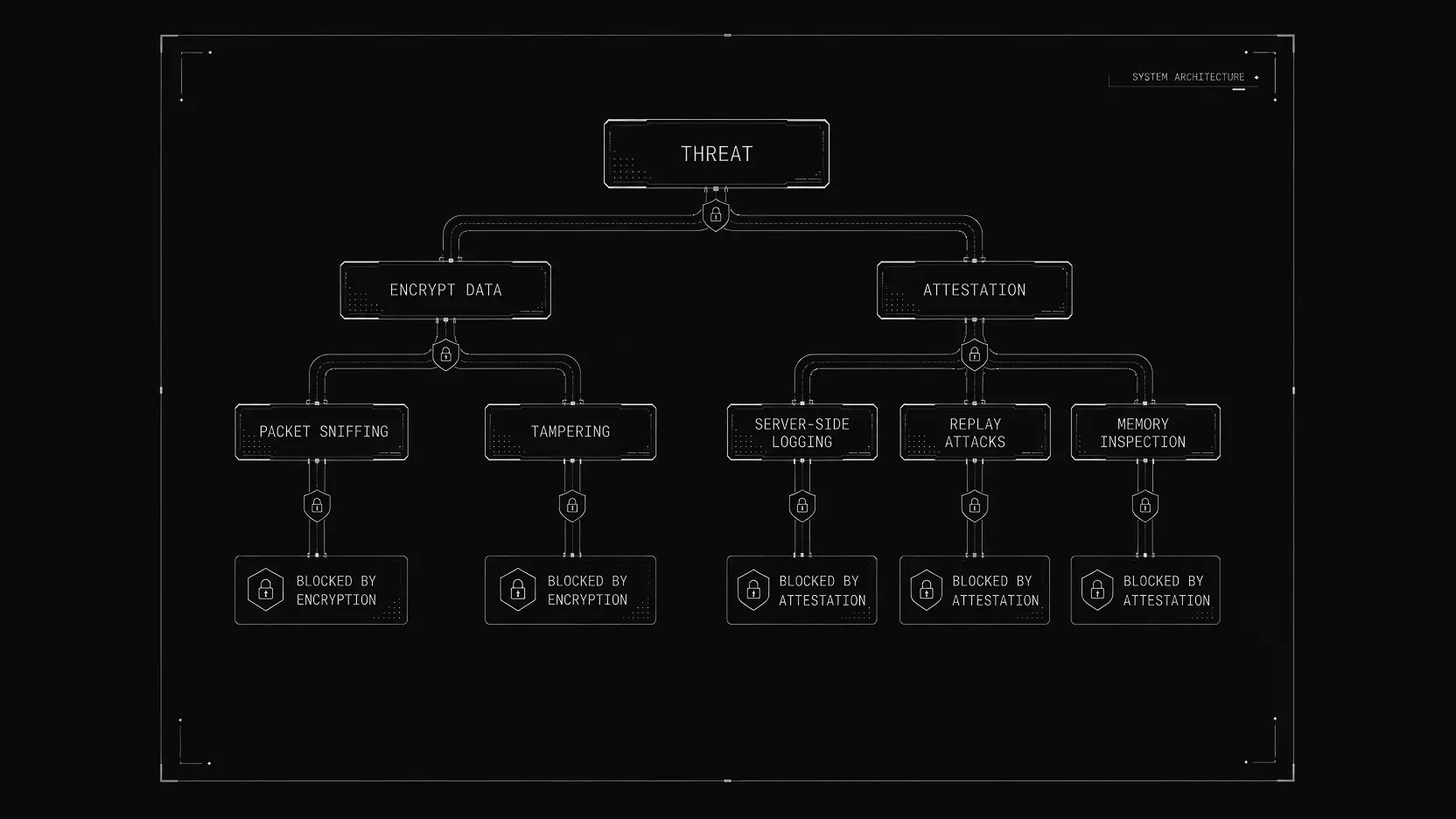
Blackbox Encrypted AI shifts the trust boundary, but it does not eliminate the need for secure application design. You still need hardened backend services, strong secrets management, careful operational controls. The platform protects the conversation while it is in transit and while it is being processed by a verified worker. It does not magically secure every system that touches the data before or after that window.
A mature deployment treats encryption as one layer in a broader defense-in-depth strategy. Access control, least privilege, secure storage, auditability, and revocation are still necessary. The advantage: the most sensitive portion of the pipeline, the LLM prompt and response path, now has stronger cryptographic protections than a typical API integration. For many enterprise workloads, that's the difference between "too risky to adopt" and "acceptable with controls."
Benchmark: 22× Cheaper Than GPT-4o, Same Encryption Guarantee
Live API calls, May 10 2026, 15:41 UTC. 6 models, 210 total requests. Methodology follows LLMPerf, NVIDIA NIM/GenAI-Perf, Artificial Analysis, and MLPerf Inference standards.
Performance: Latency and Reliability
TTFT P50: median time to first token (perceived responsiveness).
ITL Mean: average milliseconds between streamed tokens. Lower = smoother output.
ITL StdDev: streaming consistency. Lower = no stutter or bursts.
NIAH: Needle-in-a-Haystack accuracy across 4K–16K token documents.
Average milliseconds between streamed tokens. Lower means smoother output.
| Model | ms |
|---|---|
| GPT-4o | 7.5 ms |
| Blackbox Encrypted Nemotron 120B | 12.8 ms |
| Mistral Large 2 | 23.4 ms |
| Meta Llama 3.3 70B | 42.7 ms |
| Nemotron 120B (unencrypted) | 57.9 ms |
| DeepSeek V3 | 128.5 ms |
Source: live API calls, May 10 2026, 15:41 UTC. n=210 requests across 6 models.
Variability in token arrival rate. Lower means no stutter or bursts.
| Model | ms |
|---|---|
| Blackbox Encrypted Nemotron 120B | 0.4 ms |
| Mistral Large 2 | 3.6 ms |
| GPT-4o | 5.6 ms |
| Nemotron 120B (unencrypted) | 30.3 ms |
| Meta Llama 3.3 70B | 40.3 ms |
| DeepSeek V3 | 106.9 ms |
The tighter the bar, the smoother the stream. Blackbox's dedicated B200 deployment posts the lowest variability of any model tested.
Long-context retrieval accuracy. Higher is better.
| Model | % |
|---|---|
| Blackbox Encrypted Nemotron 120B | 100% |
| Mistral Large 2 | 100% |
| GPT-4o | 100% |
| Meta Llama 3.3 70B | 100% |
| DeepSeek V3 | 93% |
| Nemotron 120B (unencrypted) | 40% |
Same Nemotron weights, two deployments. The unencrypted shared-infrastructure variant drops to 40% accuracy under contention; Blackbox's dedicated B200 holds 100%.
Cost & Quality
Output $/1M: list price per million output tokens.
Tokens per $1: how many output tokens one dollar buys.
Instruction-Following: % of 15 prompts where the model obeyed a strict format constraint.
E2E Encryption: whether prompts are protected beyond TLS at the application layer.
How many output tokens one US dollar buys at list price.
| Model | tokens |
|---|---|
| Meta Llama 3.3 70B | 3.57M |
| Blackbox Encrypted Nemotron 120B | 2.22M |
| Nemotron 120B (unencrypted) | 2.22M |
| DeepSeek V3 | 1.12M |
| Mistral Large 2 | 167K |
| GPT-4o | 100K |
Blackbox is the only model in this group with end-to-end application-layer encryption at this price point.
Operational Controls: Budgets, Expiry, Revocation
Strong encryption is only part of the story. Real enterprise usage needs operational controls that help teams manage cost, lifecycle, and incident response. Blackbox Encrypted AI includes API key management features that support budgets, expiry dates, aliasing, user assignment, and revocation. A leaked or overused key isn't just a security issue; it's a financial one.
Budgets cap the potential damage of a compromised key. Tie a key to a user, team, or plan and set limits that constrain unexpected spending. Expiry dates are useful for temporary access: contractor onboarding, proof-of-concept projects, time-bound internal pilots. Revocation gives you a direct response mechanism when a user leaves, a key is exposed, or a device is suspected to be compromised.
The platform also supports operational visibility through usage, spend, and performance metrics in the dashboard. Teams monitor request volume, latency, token usage, and remaining budget. For secure enterprise deployments, this monitoring isn't optional. You need to know whether usage is trending normally, whether a key is approaching its limit, and whether repeated failures indicate authentication problems or service instability. See pricing tiers for the available budget and quota controls.
A practical control model usually looks like this:
1. One key per user for fine-grained auditing and revocation.
2. Tight spend caps for each key.
3. Short expiry windows for temporary access.
4. Automated alerting on unusual usage or budget exhaustion.
5. Immediate revocation when a key is no longer valid.
Encryption protects the conversation content; operational controls manage access, lifecycle, and cost exposure. Together, they make the platform suitable for production workflows, not just experimental prototypes.
The Takeaway
Blackbox Encrypted AI addresses the core security weakness of ordinary LLM integrations: the uncontrolled exposure of plaintext prompts and responses. API key authentication, hardware attestation, ephemeral key exchange, AES-256-GCM encryption, encrypted message handling, and careful key lifecycle controls combine into a much stronger confidentiality model for AI conversations.
“If you want to use LLMs for sensitive work, you need more than a model endpoint and TLS. You need a system that can prove the worker is genuine, keep the conversation encrypted end-to-end, and give operators real control over the keys.”
The architectural lesson is simple. For sensitive work, you need more than a model endpoint and TLS. You need a system that proves the worker is genuine, keeps the conversation encrypted end-to-end, preserves replay protection across turns, and gives operators control over budgets and revocation. Blackbox Encrypted AI is built for exactly that use case.
For teams building confidential copilots, regulated workflows, or internal AI tools that touch valuable data, this is more than a security upgrade; it's an enabler. It makes high-trust LLM adoption technically and operationally realistic. Start with the Blackbox API docs, review pricing, or read how teams use the Agents API to compose encrypted inference into multi-step workflows.
Ready to serve your first token?
Tell us the workload and the controls it has to satisfy. We come back with a deployment plan and a per-token commit.