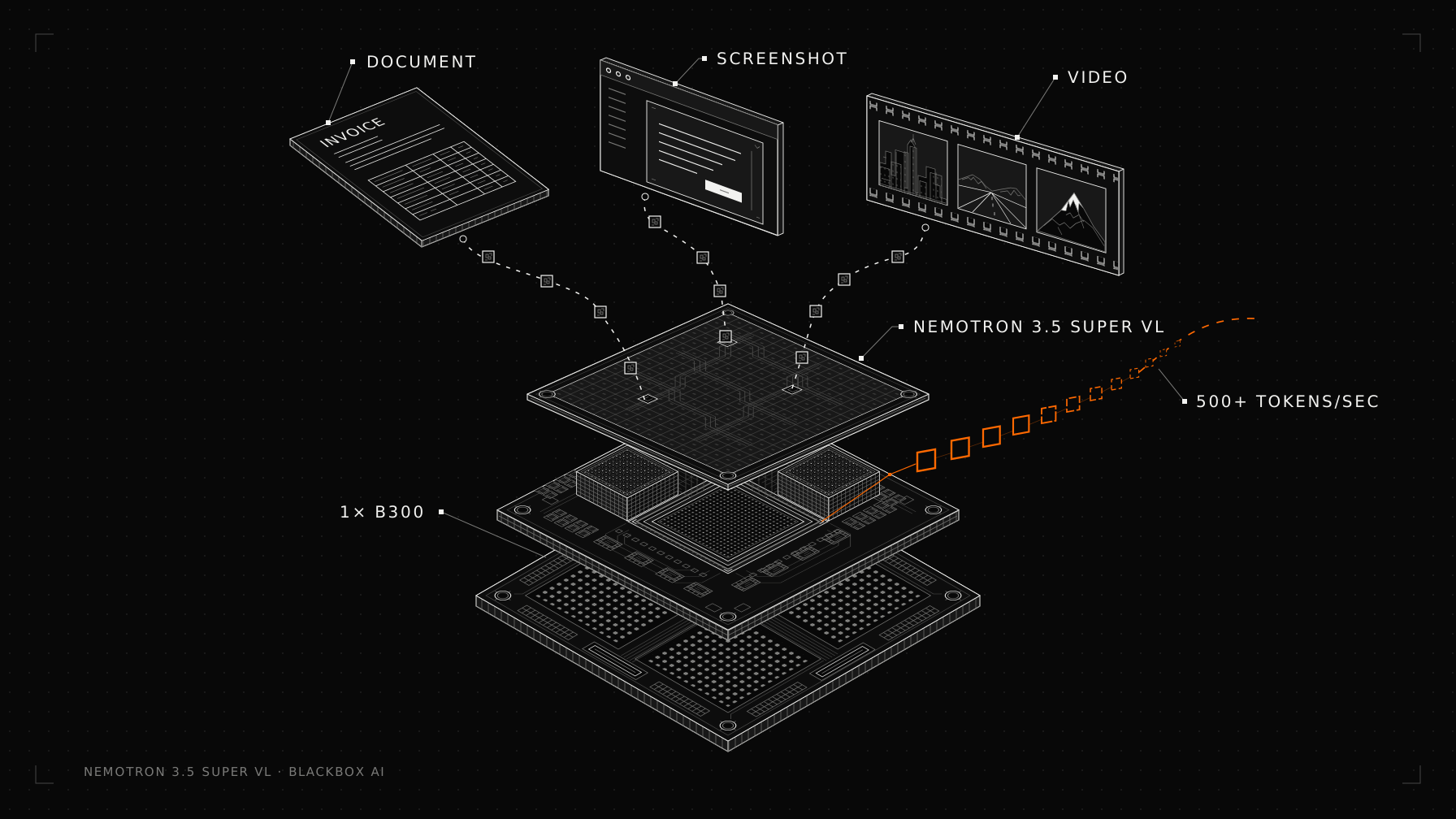
BLACKBOX AI is an official launch partner for NVIDIA Nemotron 3.5 Super VL, NVIDIA's new open multimodal model for agents that see, reason and act. It is available on BLACKBOX AI from day one through an OpenAI-compatible API.
We didn't just host it. Before launch, we tuned Super VL's serving setup on a single NVIDIA B300 GPU and made it 2.5x faster than out of the box. It now generates over 500 output tokens per second for a single request. That makes it the fastest per request of the models we compared below.
What makes Nemotron 3.5 Super VL different
NVIDIA Nemotron 3.5 Super VL is an open multimodal model for agents that see, reason, and act across specialized workflows. Its 120B-total, 12B-active MoE architecture combines text, image, document, GUI, and video understanding with agentic reasoning and tool use.
One model for seeing and acting. It reads documents, screenshots, images and video, reasons over them, and calls tools, without handing off between a vision model and a language model.
Efficient by design. A hybrid Mamba-Transformer mixture-of-experts activates only 12B of its 120B parameters per token.
Built-in Multi-Token Prediction (MTP). The model drafts several tokens ahead and checks them in one step, with no separate draft model.
C-RADIOv4 vision encoder for images, documents, GUIs and video frames.
Open and customizable. Organizations can post-train it with NVIDIA NeMo on their own data, tools and policies.
Within a system of models, NVIDIA positions Super VL as the high-accuracy multimodal execution model, alongside Nemotron 3.5 Lightning for high-volume text and Nemotron 3 Ultra for the hardest text-only reasoning.
What you can build
Super VL is built for agents whose inputs aren't just text. Before launch we checked document OCR, screenshot, image and video tasks on our own deployment.
Document intelligence. Read scanned pages, tables, charts and forms, then extract fields as structured JSON or write a summary.
GUI and screenshot agents. Find the right button in a screenshot, read an error dialog, or turn a UI mockup into a task for a coding agent.
Customer service. Handle requests that come with photos or documents, apply policy, and call your service tools.
Video understanding. Describe what happens in a clip and in what order, for search, content review and incident analysis.
Web research. Search across sites, connect what each source says, and verify the result.
Tool calling, structured output and reasoning on or off all work through the same API, so one model can look at the input, decide, and act.
How fast it runs on BLACKBOX AI
Our optimizations took Super VL from 198 to 492 output tokens per second for a single request on the same prompts, then tuning added another 8%. Here is how we got there.
1. Fit it on one GPU
NVIDIA's NVFP4 checkpoint is 75 GB, so the whole model runs on a single B300 with no tensor parallelism. We serve it with vLLM, with prefix caching and async scheduling on.
2. Turn on MTP
This was the biggest win. Before and after, on the same 6 long prompts with thinking on:
Both runs followed the same steps on a freshly started server: one warm-up request, then concurrency 1, then concurrency 6. MTP speeds up token generation, not prompt processing, so it isn't expected to shorten time to first token; at concurrency 1 that stayed about the same (0.41 s before, 0.40 s after).
3. Tune how far it drafts ahead
We ran our automated config-search over the MTP draft length, with quality checks on every candidate:
Compare rows within the same run. In run 1, drafting 5 tokens instead of 3 was 8% faster at concurrency 1 and about 14% faster at concurrency 10. In run 2, drafting 7 was 3% faster than 5 at concurrency 1 but 9% slower at concurrency 10.
Share of drafted tokens the model accepted, by position in the draft (MTP 7 run)
| Position in the draft | Value |
|---|---|
| Token 1 | 92% |
| Token 5 | 51% |
| Token 6 | 40% |
| Token 7 | 31% |
The reason is how often drafted tokens are accepted. Every drafted token costs compute to verify, accepted or not. The first drafted token was accepted 92% of the time, but the 6th and 7th only 40% and 31%. With 10 requests in one batch, that wasted verification slows everyone down, so 5 tokens is the sweet spot.

Compared with other models we serve
Same 30 prompts of about 10,000 tokens each, thinking on, median of three runs, 540 requests in total, all successful:
Output tokens/sec at concurrency 1 · Higher is better.
| Model | Value |
|---|---|
| Nemotron 3.5 Super VL 1x B300 | 521 |
| Gemma 4 31B 1x B300 | 357 |
| Nemotron 3.5 Lightning 1x H200 | 304 |
Same 30 prompts of about 10,000 tokens each, thinking on, median of three runs. Measured October 7, 2026, before MTP tuning.
Super VL was 46% faster than Gemma 4 31B on the same GPU at concurrency 1, and about twice as fast per request as Nemotron 3.5 Lightning at concurrency 10. These are our own measurements from October 7, 2026, run before the MTP tuning above. Output tokens include reasoning. Responses ran to the 1,500-token output limit, so these numbers show generation speed only, not answer quality or cost.
Get started
Super VL works with any OpenAI-compatible client. Here it reads an invoice image and returns the fields as JSON:
from openai import OpenAI

client = OpenAI(
    base_url="https://{your-org}.blackboxgpu.com/v1",
    api_key="YOUR_BLACKBOX_API_KEY",
)

response = client.chat.completions.create(
    model="YOUR_DEPLOYMENT_ID",  # your Nemotron 3.5 Super VL deployment
    messages=[{
        "role": "user",
        "content": [
            {"type": "image_url", "image_url": {"url": "https://example.com/invoice.png"}},
            {"type": "text", "text": "Extract the invoice number, date and total as JSON."},
        ],
    }],
    extra_body={"chat_template_kwargs": {"enable_thinking": True}},
    max_tokens=2048,
)

print(response.choices[0].message.content)
Video uses a video_url item in the same way. Tool calling and response_format with a JSON schema work as in the OpenAI API. When thinking is on, the model's reasoning is returned separately from the answer, so leave room for both in max_tokens.
Why run Super VL on BLACKBOX AI
Tuned and measured before launch. We don't just load the weights. Our automated config-search tests serving settings against your speed targets and quality checks, and keeps only changes that are measured to help. The numbers in this post come from that loop.
OpenAI-compatible. Swap the base URL and model name in your existing code. Streaming, tools, structured output, images and video all go through the same endpoint.
Dedicated deployments. Run Super VL on your own pinned GPU allocation, with the serving config fixed and versioned, and tune it for your workload.
End-to-End Encryption Nemotron 3.5 Super VL
Most "private" AI services simply ask for your trust. We prove it. Every model runs inside a hardware-sealed TEE enclave, so your prompts, documents, and outputs are encrypted end-to-end and remain invisible to everyone, including us.

Verify the signed image and start running encrypted inference today at https://{your-org}.blackboxgpu.com.
Ready to serve your first token?
Tell us the workload and the controls it has to satisfy. We come back with a deployment plan and a per-token commit.